Q4 Planning When to Book Your 2027 Speaker Programme
Q4 Planning: When to Book Your 2027 Speaker Programme
When should you book speakers for 2027? Booking windows, busy seasons, budget cycles and a month-by-month availability calendar for your annual speaker programme.
Many organisations start looking for speakers in December and meet the same problem. Their first choice is booked, their second choice is booked, and the fee for their third choice has gone up.
The cause is the speaker booking calendar. The most requested names fill their diaries months before the year begins.
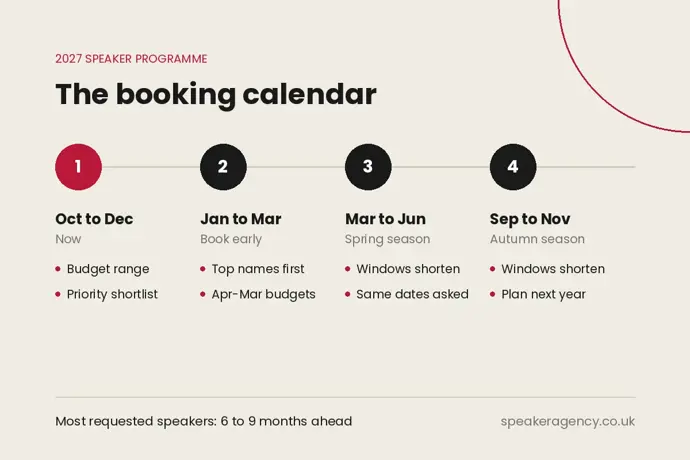
An annual speaker programme is the set of speaker bookings an organisation plans across the year: which names, on which dates, in which order, and how the budget is spread over those months. Our corporate event planning guide covers the budget and logistics of a single event. This piece answers a narrower question: when should you secure the speakers for 2027? For most organisations the answer is between October and December.
Why is Q4 the trigger?
Organisations with a calendar-year budget usually set next year's numbers between October and December. When speaker planning happens in the same window, you gain two things at once.
First, you book with an approved budget in hand. Second, you reach in-demand speakers early, while their 2027 diaries still have open dates.
Many UK organisations run a different cycle. The public sector and a large number of companies use an April to March financial year, so their budgets are set between January and March. If that is your cycle, treat Q4 as the time to build the shortlist and check availability, and confirm bookings as soon as the new budget is approved.
How does the booking window work?
Speaker availability depends on three factors: how well known the speaker is, how busy the season is, and how flexible your date is.
In our experience, the window for the most requested speakers opens 6 to 9 months ahead. For mid-profile speakers it is closer to 3 to 4 months. In the UK, the spring conference season (March to June) and the autumn season (September to November) shorten both windows, because several organisations ask for the same dates.
Date flexibility is the cheapest tool you have. An organisation that can offer a range of weeks, and not a single day, is far less likely to end up on a waiting list.
What does early booking do to the budget?
Early booking protects you from increases. Speaker fees can change during the year as demand changes, and a booking confirmed in October holds the agreed fee for the date you secured.
Can you hold a date before the budget is approved?
Often, yes. Many speakers and their teams accept a provisional hold on a date while the client completes internal approval. Terms differ from speaker to speaker, so we confirm the length of the hold and what happens when it expires in writing before you rely on it.
A provisional hold is most useful in the weeks between shortlist and budget sign-off, which is exactly where April to March organisations sit in Q4.
When should you switch to a plan B?
If your first choice is booked, you have three options: move the date, consider a speaker with a similar profile, or join the waiting list and work on an alternative at the same time.
Waiting lists often work, because cancellations and date changes happen during the year. If your event is 2 to 3 months away, do not rely on the waiting list alone. Look at the alternative speaker in parallel.
October to December is the best window for organisations with a calendar-year budget. For organisations with an April to March financial year, Q4 is the time to build the shortlist and check availability, with bookings confirmed once the budget is approved in the new year.
How far ahead do speakers get booked?
In our experience, the most requested speakers are booked 6 to 9 months ahead and mid-profile speakers 3 to 4 months ahead. During the UK spring and autumn conference seasons, both windows shorten.
Does booking early reduce the fee?
Early booking protects you from increases. Fees can change during the year as demand changes, and a confirmed booking holds the agreed fee for your date.
What should we do if our preferred speaker is booked?
Move the date, consider a speaker with a similar profile, or join the waiting list while you work on an alternative. If the event is 2 to 3 months away, look at the alternative in parallel.
How is an annual speaker programme different from planning a single event?
Planning a single event covers the logistics and cost of that event. An annual speaker programme covers which speakers you secure on which dates across the year, the order of bookings and how the budget is spread over time. The two work together and answer different questions.







 After Dinner Speakers


 Contents