Transformation happens at the intersection of knowledge and action. Demand for Mental Health Speakers UK-wide has moved decisively from HR wish-lists to board agendas — driven by a £51 billion annual cost to UK employers and a regulatory landscape that now places a proactive duty of psychological care on every organisation.
Seven mental health speakers on our UK roster
The speakers we work with most often across UK corporate and healthcare audiences, and the talks they are most often booked for. Each name links to their full profile, fees guidance and availability.
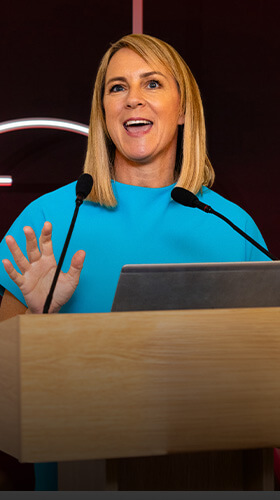
- Dr Liz O'Riordan — speaker, author and conference host. Talks include Resilience and Reinvention and Communication and Psychological Safety.
- Dr Ally Jaffee — NHS doctor and mental health advocate. Talks include Doctor's Mental Health and Vulnerability as Strength.
- Dr Alexandra Adams — the UK's first deafblind doctor. Talks include Medicine and Mental Health and What I've Learnt from Being a Patient.
- Dr Reena Kotecha — organisational wellbeing consultant, Harvard Executive Education programme leader. Talks include Mindfulness Meditation: A Core Resilience Skill for Stress Management and Emotional Intelligence in the Workplace.
- Darren Edwards — record-breaking disabled adventurer and author. Talks include The Adaptive Mindset — The Five Pillars to Overcome Adversity and Strength Through Adversity.
- Dr Elaine Kasket — cyberpsychologist and author. Talks include Beyond 'digital detox': Crafting your tech-life balance and Digital dynamics: Cyberpsychology at work.
- Dr Philippa Kaye — GP and author. Talks include Know Your Normal and Women's Health.
The Worker Protection (Amendment of Equality Act 2010) Act 2023, fully in force from October 2024, means this is no longer a welfare conversation: it is a governance one. Event organisers who once booked a mental health speaker as a goodwill gesture are now briefing them as a strategic intervention — one measured in retention figures, sickness absence rates and ESG disclosures.
Speaker Agency doesn't match names to dates; we architect the wisdom transfer your workforce actually needs to hear.
Why Hire a Mental Health Speaker for Your Event
Mental health has earned its place on the boardroom agenda — not because HR departments lobbied for it, but because the numbers have forced the conversation upward.
Workforce Productivity & Burnout Prevention — according to Deloitte's 2024 Mental Health and Employers report, poor mental health costs UK employers £51 billion annually: £24 billion in presenteeism, £7 billion in absenteeism, and £20 billion in staff turnover. These are CFO-relevant metrics — the kind that appear in FTSE 100 ESG disclosures and HR committee packs. A mental health speaker who frames burnout prevention as a productivity and retention lever, rather than a compassion gesture, lands differently with a senior audience. The organisations that get this right don't just reduce sickness absence; they build workforces that sustain high performance without burning through their people.
Psychological Safety & Legal Compliance — The Worker Protection (Amendment of Equality Act 2010) Act 2023 creates a new proactive duty for employers to prevent psychological harm at work. In force since October 2024, it has shifted line manager development from a capability-building nice-to-have into a compliance-adjacent imperative. L&D teams are now booking mental health speakers specifically to support manager awareness programmes and embed a culture of psychological safety from the team level upward.
Lived Experience as Credibility Architecture — Corporate audiences in 2026 have a low tolerance for theoretical wellbeing content. The speakers generating the highest delegate satisfaction scores combine clinical credentials or high-profile personal testimony with concrete, actionable takeaways. Generic wellness presentations — relaxation tips, work-life balance frameworks — have measurably lower repeat-booking rates. What moves a room is authority earned through actual experience, not curated from a literature review.
Mental health keynotes and broader wellbeing programming are related but distinct: if your brief is wider in scope — stress, sleep, lifestyle or physical health — our wellbeing speakers page is the better starting point.
What Sets a Great Mental Health Speaker Apart
The mental health category carries an unusually high proportion of speakers whose knowledge is theoretical rather than professionally accountable. Three questions sharpen the selection fast.
Do they carry professional accountability?
A practising clinician — GP, registered psychologist, NHS consultant — has their public statements held to a professional standard in a way that a speaker with awareness-level training does not. Dr Alex George, UK Government Mental Health Ambassador, practising A&E doctor and co-founder of Be Mettle, represents the dual authority that most corporate audiences respond to: recognisable name, verifiable clinical credentials, and a platform built on both. He can hold a room of sceptics because his expertise is structural, not self-appointed.
Is their evidence rooted in experience or in theory?
Dr Claire Ashley, a practising GP and NHS Clinical Entrepreneur specialising in workforce burnout, can answer questions from financial services or legal audiences that a researcher-only speaker cannot — because she has witnessed the clinical reality of burnout firsthand, not modelled it academically. In sectors where credibility thresholds are high, this distinction determines whether a keynote lands or merely informs.
Can they move a room without minimising the subject?
Mental health keynotes fail at two extremes: catastrophising leaves audiences anxious; over-optimising leaves them sceptical. The right speaker calibrates tone to the specific audience composition — and has done so in comparable corporate environments before, not solely at charity galas or public-sector conferences.
Many event programmes pair a mental health keynote with a session from our resilience speakers to carry the momentum from a single catalyst moment into sustained behavioural practice. That programme architecture is where wisdom transfer compounds — and designing it is what we do, not an afterthought.
When Should You Book a Mental Health Speaker
Mind's workplace mental health data shows that 1 in 6 workers experiences a mental health problem in any given week — meaning the booking trigger is a statistically predictable baseline condition in every workforce, not a crisis response.
- Annual employee wellbeing days — The most common single booking trigger; frequently anchored to World Mental Health Day (10 October) as a company-wide event or flagship session.
- Mental Health Awareness Week activations (May) — Internal events or external thought-leadership sessions during the UK's MHAW calendar week.
- Line manager development programmes — HR and L&D teams embedding psychological safety and difficult-conversation skills within broader manager capability frameworks.
- Post-restructure or change management events — After redundancy cycles, M&A or significant reorganisation, a mental health speaker addresses workforce anxiety and begins rebuilding trust.
- Graduate and early-careers onboarding — Mental health literacy as a deliberate culture signal in new joiner and graduate induction cohorts.
- ESG and D&I conference programming — Mental health sits alongside neurodiversity and disability as a core D&I pillar in internal summit agendas.
- Healthcare, legal and financial services sector conferences — Three sectors with the highest documented burnout rates; mental health speakers are a recurring feature at Law Society events, NHS leadership summits and financial services trade bodies.
These triggers are distributed across the calendar year — bookings are not confined to October or May, and the most impactful programmes treat mental health as a recurring, not a seasonal, investment.
Topics Our Mental Health Speakers Cover Most Often
The mental health category is broader than most event briefs acknowledge. A CFO briefs "performance psychology." An HR director briefs "burnout prevention." A D&I lead briefs "neurodiversity and mental health." This section maps the sub-topics the roster covers — so you can confirm your specific brief is in scope before going further.
- Burnout prevention and recovery — Booked most often by HR directors in legal, financial services and consulting firms; framed as a productivity and retention intervention, not a welfare measure.
- Psychological safety at work — Increasingly tied to line manager training and the Worker Protection Act 2024 compliance agenda; often part of a leadership development day.
- Resilience and adversity — For organisations navigating structural change, redundancy cycles or economic uncertainty; frequently paired with a resilience session for a full programme.
- Men's mental health — A targeted session within broader D&I or wellbeing days; particularly relevant in construction, engineering, finance and emergency services.
- Neurodiversity and mental health — Overlaps with D&I programming; speakers with enterprise-level credibility across Accenture, Capgemini and Adecco Group bring demonstrated corporate fluency.
- Grief and loss at work — A growing niche, activated after organisational bereavement events or following a public tragedy; requires careful speaker matching for tone and context.
- Leadership performance psychology — Booked for C-suite retreats and leadership offsites; draws on sports psychology and elite performance science rather than clinical frameworks.
- Digital wellbeing and tech-life balance — Emerging demand from technology, media and financial services firms managing always-on working cultures.
The right sub-topic determines the right speaker profile — and those two things together determine whether the session creates genuine change or simply occupies a slot in the programme.
How to Choose the Right Mental Health Speaker
By this point, you know the sub-topic. These criteria match the speaker profile to the specific audience and context.
- Clinical vs. lived-experience profile — Match speaker type to audience need: clinical practitioners (GPs, psychologists, NHS clinicians) for line manager and compliance-adjacent programmes; lived-experience speakers for culture and awareness events; performance psychologists for leadership audiences.
- Sector familiarity — A speaker who has addressed financial services burnout or NHS leadership stress arrives with relevant reference points that a generalist cannot replicate. Ask for comparable audience examples.
- Format match — A 45-minute keynote shifts mindset and creates a catalyst moment; a 2–4 hour workshop builds practical capability. These are not interchangeable outcomes — define which one your brief requires before shortlisting begins.
- Audience seniority and composition — A session for C-suite leaders demands a different register, pace and assumed vocabulary than a 200-person all-staff event or a graduate cohort.
- Sensitivity and tone calibration — Mental health content misfires when a speaker catastrophises, trivialises or applies inappropriate humour. Request recordings from comparable corporate contexts — not charity gala footage.
- Budget clarity — Mental health speakers on the UK roster start from £3,000; most corporate bookings fall between that floor and £25,000. Celebrity-adjacent speakers such as Dr Alex George are priced on request. For a full breakdown, see how much a keynote speaker costs in the UK.
How Speaker Agency Helps You Find the Right Match
Mental health briefs are among the most nuanced we handle — and the most consequential to get wrong.
- Map the wisdom gap. For mental health briefs, the gap is rarely obvious from the initial enquiry. We work with you to identify whether your workforce needs awareness-level education, line manager capability, compliance-adjacent training, or senior leader performance psychology — because each requires a fundamentally different speaker profile.
- Curate the elite voices. Drawing on our 300+ UK roster and 1,190+ global network, we match clinical practitioners, lived-experience speakers, and performance psychologists to your specific brief — delivering a tailored shortlist within 24 hours.
- Architect the catalyst moment. We don't supply a speaker and step back. We help you design the transformation blueprint around the session — format, pre-event framing, audience preparation, and post-session signposting — so the keynote becomes a genuine catalyst moment, not a one-off event.
- Sustain the momentum. Post-session, we advise on follow-on resources, workshop series, and internal champion programmes that convert a single catalyst moment into sustained cultural and behavioural change across your organisation.
Speaker Agency operates as a Wisdom Catalyst for mental health programming across the UK, Europe and Türkiye. Whether you are building a single keynote, a multi-session leadership programme, or a recurring annual framework, our advisory team treats every brief as a strategic architecture question — not a transaction. The goal is not a speaker on a stage; it is a workforce that thinks and behaves differently after they leave the room.







 After Dinner Speakers

 Discover Similar Topics