Your next breakthrough is one wisdom transfer away. The conversation around Creativity Speakers UK has sharpened considerably — what corporate buyers are asking in 2026 is no longer "should we invest in creative thinking?" but "how do we build it as a durable organisational capability?"
The World Economic Forum's Future of Jobs Report 2025 ranks creative thinking as the single most important skill for workers through 2030 — ahead of analytical reasoning, AI literacy, and resilience — and that finding is now landing in boardrooms, not just L&D planning cycles. Meanwhile, the UK's creative industries contribute over £124 billion in annual GVA, signalling that creativity is a structural economic priority with measurable commercial weight.
As AI absorbs routine cognitive work, human creative capacity becomes the differentiating resource boards are actively investing in. Speaker Agency doesn't source inspirational names — it architects wisdom transfer that converts a single keynote into lasting creative capability across the organisation.
Why Hire a Creativity Speaker for Your Event
Creative thinking is no longer a soft skill on the periphery of corporate strategy — it is the primary differentiator boards are being asked to develop, measure, and protect.
Creative Thinking as Competitive Differentiator is the argument that moves CFOs. The Future of Jobs Report 2025 — drawing on employer citations across 22 global industry clusters — ranks creative thinking #1 among the skills workers will need through 2030, above analytical reasoning and AI literacy. The organisations that treat creativity as a measurable capability — with structured investment, dedicated programming, and senior sponsorship — are demonstrably pulling ahead of those that treat it as personality-dependent and impossible to scale.
Creativity in the Age of AI: Human-First Advantage is the question every forward-facing leadership team is now sitting with. As AI handles synthesis, pattern recognition, and first-draft generation, the distinctively human contribution becomes harder to define and easier to undervalue — until a competitor defines it first. A creativity speaker working at this intersection doesn't offer reassurance; they provide a working framework for how human creative capacity and machine capability divide and combine in practice.
Building Organisational Creative Capacity is where the CHRO and L&D Director case lives. The DCMS Sector Economic Estimates: GVA 2024 confirms that the UK's creative industries generated over £124 billion GVA in 2023 — approximately 5.7% of total UK GVA — demonstrating that creativity at scale has architecture behind it, not just talent. The shift from hiring one creative individual to building the conditions under which creativity emerges at team and enterprise level is the most consequential organisational design question of this decade.
Before you shortlist a speaker, the choice of sub-angle — competitive differentiation, AI-adjacency, or cultural embedding — determines everything about which voice the room actually needs.
What Sets a Great Creativity Speaker Apart
The credibility gap between a practitioner and a commentator is nowhere more consequential than in creativity — a topic where motivational anecdote is cheap and boardroom-grade evidence is rare.
Do they make the business case, not just the creative case?
A speaker who has spent twenty years arguing, inside real organisations, that creativity and commercial rigour belong in the same sentence brings something a theorist cannot: the scar tissue of having made that argument to a sceptical CFO and won.
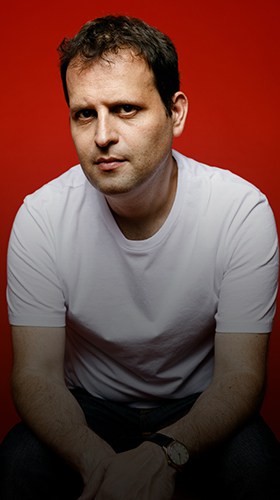
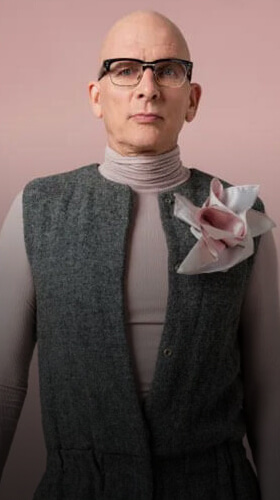
Alan Moore, founder of the Design School for Beautiful Business, has spent two decades building the intellectual and commercial case that beauty and creative thinking are competitive strategy — not aesthetic indulgence. When your audience includes finance directors and COOs, the speaker who can draw a direct line from creative methodology to revenue impact will do more work than one who inspires the room and disappears.
Buyers distinguishing methodology-led practitioners — including design thinking speakers who bring structured process frameworks — from inspirational storytellers should treat this as the first fork in the road.
Have they built or broken creative cultures at scale?
Organisational track record is the evidence that no academic model can replicate. Bruce Daisley — twice a Sunday Times bestselling author and former Twitter VP Europe — has first-hand experience of how creativity flourishes or collapses in workplace culture, particularly in hybrid and distributed teams where the informal conditions for creative exchange are hardest to preserve. That's the operator's perspective from someone who has actually led under pressure, not a case study reconstructed after the fact.
Can they hold a room of sceptics, not just true believers?
The audience most worth converting is the one that arrives unconvinced. Engineers, risk officers, and CFOs push back differently — and a creativity speaker who can only energise the already-converted adds limited strategic value. The capacity to hold that room, answer the hard commercial questions, and leave the sceptics with a changed position is the differentiator that matters most when the stakes are high.
Speaker Agency's role here is not to pick a name from a list — it is to identify which dimension of creative wisdom the organisation is actually missing and match the wisdom architecture accordingly.
When Should You Book a Creativity Speaker
The contexts below are the scenarios where a creativity speaker creates the most measurable shift — use them as a rapid check against your own event brief.
Annual strategy offsites — Leadership teams resetting direction benefit from a creativity speaker who reframes how the team defines problems before solutions are discussed.
Innovation Days and Hackathons — A pre-session keynote shifts participant mindset from incremental to generative thinking; for deeper programming, disruptive innovation speakers are a natural companion strand.
Sales Kickoffs — Creative thinking applied to competitive differentiation, pitch construction, and customer empathy — for sales teams moving beyond feature-led selling.
Post-merger and transformation programmes — When two cultures are integrating, a creativity speaker establishes shared vocabulary for how the combined organisation will generate and evaluate new ideas.
Learning and Development conferences — Internal events where the meta-message is building a learning organisation; creativity positioned as a learnable organisational skill, not an innate talent.
Marketing and brand summits — Agencies, in-house brand teams, and CMO forums where creative culture connects directly to commercial output.
Leadership development programmes — Mid-to-senior manager cohorts being equipped with tools to unlock creative capacity in their direct reports — the multiplier buyer case.
These scenarios overlap more than they appear to: a post-merger transformation programme and a leadership development cohort often need the same speaker — and often need them in sequence.
Topics Our Creativity Speakers Cover Most Often
Creativity spans distinct sub-disciplines — each capable of anchoring a standalone programme or complementing a broader event agenda.
Creative Problem-Solving — Structured methodologies such as lateral thinking, SCAMPER, and design sprints applied to live organisational challenges, not hypothetical exercises invented for the session.
Innovation Culture — The conditions — psychological safety, leadership behaviours, physical environment — that allow creativity to emerge repeatedly rather than accidentally, and how to engineer them deliberately.
Design Thinking — Human-centred problem framing and rapid prototyping repositioned as a cross-functional organisational capability, not a tool reserved for the design team.
AI and Human Creativity — What remains distinctively human when AI handles synthesis and pattern recognition; how creative teams work alongside generative tools with confidence and a clear sense of their own contribution. This is the sharpest question on most 2026 event briefs, and the speakers who answer it well do so from practice, not from principle.
Storytelling for Business — Narrative as a commercial and leadership skill: pitching ideas, building internal buy-in, and communicating strategy through story rather than through slide decks audiences have stopped reading.
Creative Leadership — How leaders at every level create the conditions for creative output in their teams — the multiplier skill behind every creative culture worth sustaining.
Cross-functional Collaboration — Breaking silo thinking by designing creative processes that work across disciplines, departments, and geographies, rather than treating creativity as something that happens inside one team.
The breadth of these clusters is itself the selection challenge: knowing which topic your organisation actually needs requires a sharper read of the wisdom gap than most event briefs capture — which is precisely where the advisory conversation starts.
How to Choose the Right Creativity Speaker
A checklist focused on the specific complexity of creativity as a topic — where the line between an inspirational storyteller and a methodology practitioner matters more than it does in most other subject areas.
Sector fit — A creativity speaker's examples land harder when drawn from the audience's own industry. Confirm the speaker has case studies or client relationships in a sector adjacent to yours — not just generic corporate examples.
Practitioner versus commentator — Has this speaker built, led, or materially changed a creative culture? Or do they primarily synthesise other people's work? For sceptical audiences — and most senior audiences are — that distinction is decisive.
Format match — A 45-minute keynote, a half-day workshop, and a multi-session facilitation programme require different speakers. Not all creativity speakers can do all three well; establish the format before shortlisting, not after.
Audience seniority — A C-suite creativity keynote requires commercial framing and strategic language. An all-hands creative culture session needs a different tone, structure, and energy entirely. The speaker who excels in one setting may underdeliver in the other.
AI-and-creativity readiness — Given how acute the human-versus-AI creativity question is in 2026, confirm the speaker holds a substantive, current view — grounded in practice — rather than a generic reassurance that AI "enhances" human creativity without explaining how or at what cost.
Sceptic readiness — If the room includes CFOs, engineers, or risk officers, the speaker must be able to convert unconvinced participants, not simply energise those already on board.
Corporate creativity keynotes start from £5,000; top-tier practitioners reach £50,000. For a full breakdown of what those fee bands reflect in practice, see what a keynote speaker costs in the UK.
How Speaker Agency Helps You Find the Right Match
Selecting the right creativity speaker requires a precise read of the organisation — not a shortlist generated from a category search.
Map the wisdom gap. The first question is not "which speaker?" — it is where the organisation's creative deficit actually sits. Whether the problem is ideation process, leadership behaviours that suppress creative risk-taking, cultural inertia, or a team's uncertainty about its role alongside AI tools, that diagnosis shapes every subsequent decision.
Curate the elite voices. From a 300+ UK roster and a 1,190+ global network — spanning design-led practitioners, behavioural scientists, and leaders who have built creative organisations from the ground up — we produce a targeted shortlist within 24 hours. Breadth of expertise matters here: the right creativity speaker for a product engineering team is rarely the right speaker for a CMO forum, and the shortlist should reflect that distinction.
Architect the catalyst moment. Speaker selection is one decision inside a larger design question. The transformation blueprint — format, session sequencing, audience activation, follow-up structure — determines whether the event creates a genuine shift in how the organisation thinks and works creatively, or simply generates a room of positive survey scores.
Sustain the momentum. Wisdom transfer continues beyond the keynote. Whether through workshop follow-ons, leadership toolkits, or a phased programme that embeds creative thinking as an organisational practice rather than a one-day event, the goal is changed capability — not a memorable morning.
Speaker Agency operates across the UK, Europe, and Türkiye as a Wisdom Catalyst — a strategic advisory partner, not a directory. Where a traditional agency returns a list, we return a recommendation grounded in a read of your organisation's specific creative gap, its audience, and the conditions under which a speaker can create lasting change. That is the difference between booking a speaker and architecting an outcome.






 After Dinner Speakers

 Discover Similar Topics