Strategy without wisdom is gambling. The conversation about cybersecurity speakers UK organisations are booking has shifted — what boards and security teams are asking in 2026 is sharper, more urgent, and far harder to answer with a standard awareness presentation.
The UK's National Cyber Security Centre managed its highest-ever volume of severe incidents in 2023–24; ransomware and AI-enabled social engineering are no longer edge-case risks for enterprise IT teams — they are board-agenda items across every regulated sector. Meanwhile, DSIT's own data shows half of UK businesses experienced a breach in the past year, yet fewer than a quarter have a formal incident response plan.
That gap is not a technology failure. It is a wisdom failure — and it is precisely the kind of failure that the right speaker, in the right room, is built to close. Speaker Agency doesn't search for a name to fill a slot; we architect the wisdom transfer that shifts an organisation's security culture from passive awareness to active defence.
Why Hire a Cyber Security Speaker for Your Event
The numbers are unambiguous. According to the Cyber Security Breaches Survey 2024, 50% of UK businesses experienced a cyber breach or attack in the past 12 months — yet only 22% have a formal incident response plan in place. The distance between those two figures is not a procurement gap. It is a knowledge gap, and it sits squarely in the space that a well-chosen speaker is designed to close.
Human-layer risk is where most breaches begin, and where most awareness programmes fail to reach. The mechanics of a phishing campaign or a social engineering call are not primarily technical — they are psychological. A cyber security speaker who understands behavioural science alongside threat intelligence can shift staff from passive recipients of policy to active participants in organisational defence. This is the highest-volume booking type on the UK calendar for good reason: behaviour change at scale requires a catalyst moment, not a compliance slide deck.
Board and C-suite accountability has moved from background concern to regulatory obligation. FCA and PRA operational resilience frameworks, the UK cyber resilience strategy, and the regulatory direction of travel have collectively elevated cyber from an IT function to a board-reported risk. Senior leaders need expert voices who can translate technical exposure into financial consequence and reputational liability — in the precise register a non-technical board will act on.
Emerging AI-enabled threats represent the frontier that most speaker rosters cannot yet address credibly. Synthetic voice fraud, deepfake executive impersonation, and AI-generated phishing at scale are 2025–2026 board concerns — not because they are science fiction but because they are already appearing in incident logs. Only speakers with genuine generative AI and security crossover expertise can answer a room that has already read the headlines.
The choice of angle determines everything else about the booking. Identify which of these three gaps your event needs to close — then choose the speaker who can close it.
What Sets a Great Cyber Security Speaker Apart
Selection criteria matter here more than in almost any other topic category — because the gap between a practitioner and a commentator is invisible from a biography but immediately apparent when the questions start.
Have they operated inside the threat?
A speaker who has held a CISO seat, worked as an ethical hacker, or operated inside an intelligence environment can answer questions from a sceptical engineering team that a commentator cannot — because they have made the decisions, not just studied them.
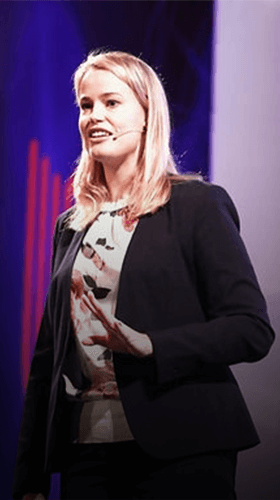
Dr Jessica Barker represents the archetype at its strongest on the human-behaviour side: a PhD-level academic, bestselling author of Confident Cyber Security, and one of the UK's most recognised voices on the psychology of security culture. She brings the kind of evidence-based depth that holds a room of HR directors and a room of security professionals simultaneously.
Can they shift registers across the room?
The best cyber security speakers can address a CISO and a CFO in the same session — translating packet-level risk into financial exposure and reputational consequence without losing either audience. This cross-register fluency is the skill that board-facing cyber events require, and it is rare. Speakers who also understand artificial intelligence speakers' territory — AI-enabled attacks, deepfake detection, generative threat modelling — can cover both dimensions without the session fracturing into two separate conversations.
Do they leave the room with actions, not just alarm?
Threat severity is easy to convey; it can also paralyse. Speakers who close with a clear, audience-specific set of next actions — graded by urgency and role — consistently outperform those who end on a climax of risk data. The measure of a cyber security session is not whether the audience felt alarmed. It is whether they changed behaviour the following Monday.
Selecting a cyber security speaker is not a procurement task. It is the first decision in a wisdom architecture that will determine whether your organisation's security culture shifts or stagnates — and that decision deserves the same rigour you would apply to any board-level risk investment.
When Should You Book a Cyber Security Speaker
Certain organisational moments make a cyber security speaker not useful but essential. The NCSC Annual Review 2024 recorded 430 cyber incidents managed in 2023–24 — up from 371 the prior year, with a significant rise in incidents affecting critical national infrastructure and supply chains. These are not abstract numbers for regulated-sector event teams; they are the direct context for every booking below.
- Cyber Awareness Month events (October) — Annual all-staff sessions where measurable behaviour change is the deliverable. The highest-volume recurring booking pattern on the UK cyber calendar.
- Board and audit committee briefings — Senior leaders navigating FCA/PRA operational resilience obligations need expert translation into strategic and reputational language. Highest fee tolerance; longest lead time required. For organisations whose cyber brief overlaps enterprise risk, our risk management speakers complement this brief directly.
- Security Operations / SOC team days — Practitioner audiences who benefit from attacker-perspective speakers — ethical hackers, former intelligence operatives — rather than compliance narrative.
- Financial services industry summits — Banking and insurance sectors face FCA cyber obligations and are watching the regulatory direction of travel closely; cyber speakers are a natural content fit.
- Technology all-hands and developer conferences — Engineering-led audiences who need threat modelling and secure-by-design thinking delivered in their own register.
- HR and People leadership conferences — Phishing psychology and the behavioural science of deception sit squarely within the people team's workforce resilience remit.
- Supply chain and procurement events — Third-party and vendor risk has made cyber a procurement agenda item; speakers addressing supply-chain threat models are increasingly in demand across manufacturing, logistics, and professional services.
These use cases combine — a financial services all-hands during October, for example, carries the weight of three of them at once.
Topics Our Cyber Security Speakers Cover Most Often
Event organisers working in this space self-sort by sub-topic before they self-qualify on speaker profile. The list below maps to the briefs we receive most frequently — if you recognise yours, it will shape the shortlist we build for you.
- Social engineering and phishing — The psychology of deception and practical defence techniques that staff can apply immediately.
- AI-enabled attacks and deepfakes — Synthetic voice fraud, AI-generated phishing at scale, and deepfake executive impersonation — the 2025–2026 threat frontier.
- Ethical hacking and the attacker's mindset — Offensive security perspectives that fundamentally reframe how organisations think about their own defences.
- Board-level cyber governance — Risk appetite, fiduciary duty, regulatory exposure, and crisis communication for non-technical senior leaders.
- Data privacy and compliance — GDPR, the UK Data Protection Act, and sector-specific obligations translated into plain language.
- Operational resilience — Business continuity, incident response planning, and the regulatory resilience frameworks that boards are now accountable for.
- Cyber culture and human behaviour — Building a security-conscious workforce without creating a surveillance culture — the balance most organisations have not yet found.
- Supply chain and third-party risk — Vendor assessment, contractual safeguards, and the supply-chain threat model that post-MOVEit audits have made urgent.
Speaker Agency matches the right sub-topic specialist to your audience's specific maturity level and sector context — a board session on governance requires a different voice than a developer day on secure-by-design, even when both are filed under "cyber security."
How to Choose the Right Cyber Security Speaker
Mismatching a speaker's register to the audience is the single most common failure mode in cyber security bookings — and it is entirely avoidable with the right brief.
- Sector fit — Regulated sectors carry distinct compliance vocabularies. A speaker briefed on FCA operational resilience speaks differently from one calibrated for NHS clinical governance or CNI. Confirm the sector before the shortlist is built.
- Practitioner versus commentator — Operational experience — CISO, intelligence operative, ethical hacker — distinguishes speakers who can handle adversarial Q&A from those who cannot. For technical audiences, this is non-negotiable; for board audiences, it is what gives the session authority.
- Format match — A 45–60 minute keynote, a half-day workshop, and a closed board session require fundamentally different speaker profiles. Format should be confirmed before the brief is written, not after the speaker is selected.
- Audience seniority and technical literacy — An all-staff awareness session and a SOC team day require different content registers. Specify both seniority level and technical baseline in the brief — these two variables do more to shape the shortlist than any other.
- Time horizon — Current threat awareness, near-term regulatory compliance, and 3–5 year strategic positioning call for different depths of expertise. The speaker's knowledge should match the horizon your audience is planning against.
- Sceptic readiness — Board members, CFOs, and engineering teams all push back differently. Confirm the speaker has held adversarial rooms, not merely receptive ones — the Q&A is where the credibility gap shows.
For teams in the early stages of budget planning, our guide on how much a cyber security keynote speaker costs in the UK sets out the full fee-tier landscape across formats and seniority levels.
How Speaker Agency Helps You Find the Right Match
Every cyber security booking starts with a different problem — and the quality of the match depends entirely on how precisely that problem is named before the search begins.
- Map the wisdom gap. Every cyber security brief starts differently — some organisations need to shift staff behaviour, others need to equip a board to answer a regulator, and others need to confront an emerging AI-enabled threat they have not yet named. We begin by diagnosing precisely which knowledge gap is costing your organisation, and in which room it needs to close.
- Curate the elite voices. From our 300+ UK roster and 1,190+ global network, we identify the speakers whose practitioner depth, sector fluency, and audience register match your specific brief — and we deliver a verified shortlist within 24 hours.
- Architect the catalyst moment. We do not confirm a speaker and send a contract. We build the transformation blueprint: format, pre-event audience briefing, content calibration, and the room conditions that convert a cyber security talk into an organisational security-culture shift.
- Sustain the momentum. The catalyst moment is the beginning, not the end. We advise on post-event reinforcement — follow-on sessions, internal communication hooks, and the resources that convert a single keynote into lasting behavioural change across the organisation.
This is the distinction that separates a Wisdom Catalyst from a speaker directory. A directory returns names. We return a strategic wisdom transfer — designed around your organisation's specific maturity, sector obligations, and the gap between where your security culture is today and where it needs to be. Speaker Agency operates across the UK, Europe, and Türkiye, with direct access to the practitioners, intelligence operatives, and governance experts who are shaping how organisations defend themselves in 2026.






 After Dinner Speakers

 Discover Similar Topics