Workshop is one of the most used yet least accurately used words in the corporate calendar. Call a meeting a workshop and attendance rises, expectations climb. Then the lights dim, a slide deck begins and participants spend two hours listening. The session may carry the name workshop; what actually took place was a presentation.
This article does two jobs at once. It first pins down what a workshop really is, then walks through how to design a corporate workshop step by step. The aim is simple: at your next event, the name of the format and its content should match.
What Is a Workshop?
A workshop is a working session in which participants create something together, guided by a facilitator and aimed at a specific goal. The word traces back to the craft workshop, where people made things with their own hands under the guidance of a master. The corporate workshop runs on the same logic: participants produce together, towards a defined outcome, with a facilitator steering the process.
The definition rests on three load-bearing elements. The first is active participation; a workshop has no audience seats, everyone works. The second is a tangible output; when the session ends, there is a decision, a roadmap, a prototype or a prioritised list of ideas on the table. The third is the facilitator; instead of a lecturer delivering content, there is a guide who manages the process, directs the questions and moves the group towards the goal.
If any of these three elements is missing, you are looking at a different format. It may be a presentation, a seminar or a training session; it is no longer a workshop.
What Is the Difference Between a Workshop, a Seminar and Training?
All three formats belong to the world of corporate learning. The difference between them is a matter of purpose and role far more than a matter of quality.
Dimension | Workshop | Seminar | Training |
Core purpose | Create together, reach decisions | Transfer knowledge and perspective | Build skills |
Participant role | Active producer | Listener, question-asker | Learner through practice |
Who owns the flow | Facilitator | Speaker | Trainer |
Group scale | Small, around tables | Suits large auditoriums | Mid-sized classroom |
Tangible output | Decision, roadmap, prototype | Notes, inspiration, perspective | Measurable competence |
One more format belongs alongside this table: the masterclass. A masterclass is a premium format in which a deeply experienced expert transfers knowledge and experience through an intensive programme. Where the goal is expert knowledge transfer, our Master Class programmes are designed around exactly that need.
Format choice does not end with the workshop question. The role of the person managing the flow on stage also changes with the format. For the detail of that distinction, see what does an event moderator do.
The 5 Steps of Corporate Workshop Design
A good workshop is never improvised. It demands a clear design process behind the scenes. The five steps below form the backbone of corporate workshop design.
Step 1: Reduce the goal to a single sentence. Workshop design begins with a goal sentence. "Let's discuss our new product strategy" does not qualify as a goal; "by the end of the session we will have chosen one of three candidate strategies" does. The goal sentence describes the output. If the output cannot be described, the wrong format has been chosen; perhaps a seminar, perhaps a keynote is what the moment needs.
Step 2: Define the participant profile and the scale. A workshop's power comes from everyone having a voice. The invitation list should therefore stay lean. The right question is "who owns and who will implement this decision" rather than "who would we like to attend". A mix of seniority levels usually adds richness; in strongly hierarchical cultures, however, the presence of senior leadership can dampen open discussion. The facilitator should know this risk at the design stage.
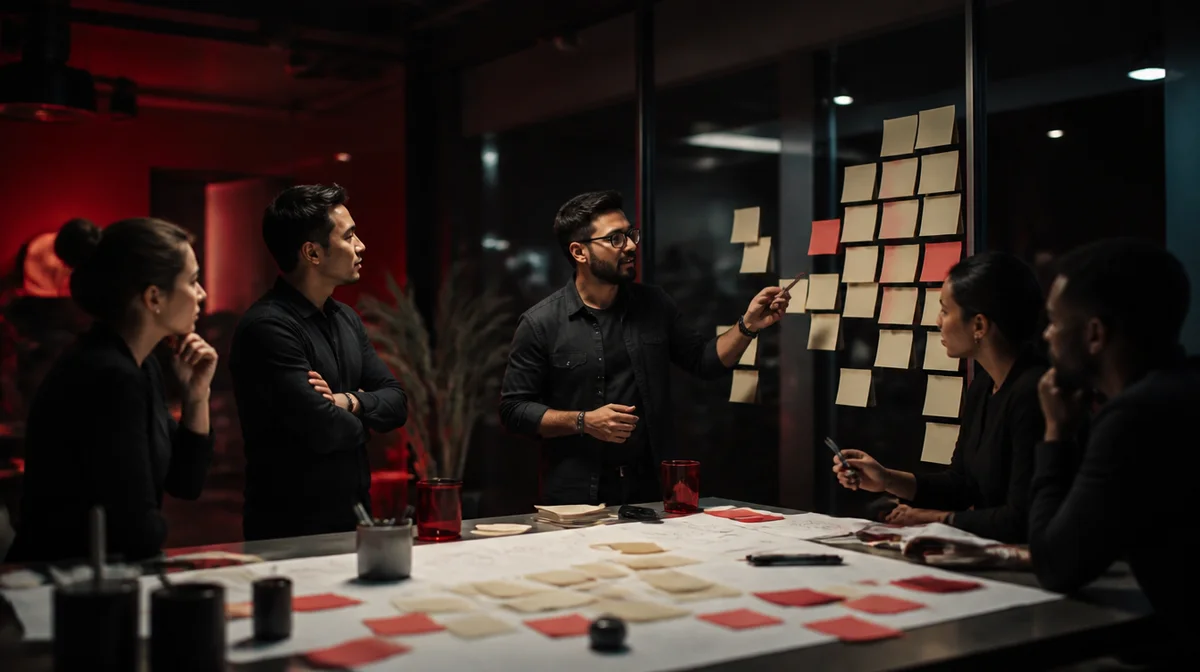
Step 3: Split the flow into production blocks. A good workshop flow is built on rhythm. It opens with a short framing talk, followed by a warm-up exercise. Then the production blocks begin: individual thinking, small group work, shared discussion and narrowing down. A decision block closes the session. The duration and output of each block is written down in advance. A workshop without a time plan turns into the agenda of its most talkative participant.
Step 4: Choose the facilitator and the materials. A facilitator from within the organisation knows the process yet can struggle to stay neutral. An external facilitator brings neutrality and method; in return, they will ask for a preparation briefing to learn the company context. On materials, the rule is plain: every production block needs its template, board or cards ready. The moment a participant has to ask where to write what, the energy drops.
Step 5: Assign owners to the output and set a follow-up plan. A workshop's real test begins after the session. At the close, every decision receives an owner and a date. A short session summary goes out to participants. The follow-up meeting goes into the calendar that same day. Skip this step and everything produced is forgotten along with the sticky notes on the wall.
Which Goals Suit a Workshop?
The workshop is a powerful format; it does not fit every goal. The right match is built as follows.
The goals a workshop serves are well defined. Reaching a decision, narrowing down strategy options, generating new ideas, redesigning a process, aligning teams and jointly searching for the root cause of a problem form the body of that list. The common thread: the answer is in the room, held in the knowledge and experience of the participants.
When the answer is not hidden in the room, the format should change. If the aim is to transfer new knowledge, a seminar or a masterclass works more efficiently. If the aim is measurable skill, a training programme is needed. If the aim is to light the emotional spark of a major transformation, the keynote takes the stage. Most strong corporate events chain these formats back to back: an inspiring keynote in the morning, then an afternoon workshop that turns the inspiration into decisions. If the transformation on your agenda is driven by artificial intelligence, our guide on how to choose an AI keynote speaker covers that selection in detail.
The Qualities of a Good Facilitator
The fate of a workshop rests largely in the facilitator's hands. The qualities that set a good facilitator apart line up as follows.
Neutrality. The facilitator defends the integrity of the process instead of competing on content. A facilitator who puts their own opinion on the table suppresses the participants' opinions.
Craft in questioning. A good facilitator sharpens the question rather than supplying the answer. Questions such as "why do you see it that way" and "what would someone arguing the opposite say" raise the quality of thinking in the room.
Time discipline. They protect each block's duration and never let a discussion, however productive, steal time from the closing decision.
Reading the room. They notice early when the energy dips, when a participant falls silent, when a tension is growing, and they adjust the flow accordingly.
The power of synthesis. They gather scattered discussion, turn what has been said into a structured decision and make sure the sentence that leaves the room is understood the same way by everyone.
At a Glance
A workshop is a facilitated working format in which participants produce a tangible output together. Active participation separates it from the seminar; output focus separates it from training. The five design steps are the goal sentence, the participant profile, a block-based flow, facilitator selection and the follow-up plan.
If you would like to define the right format and the right facilitator for your organisation together, get in touch with the Speaker Agency team. Where the need is deep expert knowledge transfer, our Master Class programmes can be considered as a lane of their own.
Frequently Asked Questions
What is a workshop in simple terms?
A workshop is a facilitated working session in which participants take an active role and produce a tangible output by the end, such as a decision, a roadmap or a prioritised set of ideas. Sessions built mainly around listening fall outside the definition.
What is the difference between a workshop and a seminar?
In a seminar, the speaker presents while participants listen and ask questions; the purpose is knowledge transfer. In a workshop, participants produce and a facilitator manages the process; the purpose is to create a decision or ideas together. In short, the seminar works around the stage, the workshop around the table.
How long should a corporate workshop last?
The goal sets the length. Settling a single decision can fit into a half-day session; layered goals such as strategy design call for a full day or a series of consecutive sessions. The rule: long enough for the output in the goal sentence, short enough to protect the energy in the room.
How many people make a workshop productive?
The productive scale is the one where everyone can speak. As the group grows, participation thins out; the answer then is parallel tables, each given its own sub-goal. Narrowing the invitation list with the question "who owns and who will implement this decision" is the healthiest method.
Is a workshop facilitator the same as a trainer?
The roles differ. The trainer is the expert on the content and builds skills; the facilitator is the expert on the process and helps the group produce its own answer. One person can carry both roles; wearing both hats in the same session, however, usually weakens each of them.
How do you find a facilitator for a corporate workshop?
Once your goal sentence and participant profile are clear, you look for a name that fits both. The Speaker Agency portfolio includes facilitators who run workshops in strategy, innovation, leadership and team development; share your brief through our [contact](https://www.speakeragency.co.uk/contact) page.







 After Dinner Speakers


 Contents