Your next breakthrough is one wisdom transfer away. The demand for Space Speakers UK has shifted decisively — corporate boards that once treated space as a science department curiosity now carry direct commercial exposure to it.
The UK space sector generated £17.5 billion in income in 2022/23 and employs approximately 47,000 people directly; risk committees, investment leads, and technology officers are booking space sessions because the sector has board-level financial stakes, not because the subject is spectacular.
Meanwhile, the decision-making frameworks developed under the most unforgiving conditions in human history — where a wrong call 250 miles above the Earth ends in catastrophe — have yet to find their way into most boardrooms. That is the wisdom gap. Speaker Agency exists to architect the moment where it closes.
Why Hire a Space Speaker for Your Event
Space is no longer a procurement category for science conferences. The organisations that book space speakers today are financial services firms, defence contractors, technology boards, and leadership teams — and the argument they are making is commercial, not inspirational.
The UK space economy as a board-level reality has arrived without much fanfare in the event industry. According to the Size and Health of the UK Space Industry 2023 report, the sector generated £18.9 billion in income in 2021/22 and directly employed around 52,000 people (full-time equivalent). For any organisation with exposure to satellite infrastructure, earth observation data, or space-adjacent technology investment, this is a session with executive accountability attached.
The global commercial space trajectory compounds the case. Morgan Stanley projects the global space economy will exceed $1 trillion by 2040 — up from approximately $630 billion in 2023, driven by satellite broadband and reusable launch systems. For corporate audiences in finance, technology, and private equity, that trajectory is not background context; it is investment intelligence. A space speaker at a sector summit or LP event is not decoration — they are the most informed person in the room on where a substantial portion of global capital is heading.
Transferable operational wisdom is the third argument, and the most underused. The risk frameworks born of Challenger, Columbia, and Apollo 1 — how decision chains fail, how organisations normalise deviation, how silence in a hierarchy becomes a fatality — are not space-specific lessons. They are executive-level frameworks for any regulated industry, safety-critical infrastructure programme, or governance board that needs to understand how catastrophic errors are actually made. Systems thinking at this depth is rarely available from conventional management keynotes.
Book a space speaker because the conditions of spaceflight have produced the most rigorously stress-tested decision-making frameworks available to any corporate audience — not because space is remarkable.
What Sets a Great Space Speaker Apart
The gap between a compelling space speaker and a forgettable one is not biography — it is whether they have done the thing they describe, and whether they can make its relevance felt in a room full of people who build financial models or run supply chains.
Have they operated in the environment they describe?
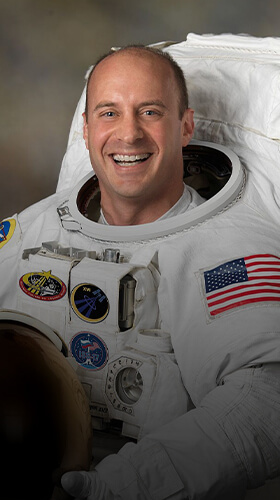
A speaker who has trained for years, lived aboard the ISS, or built the commercial infrastructure of the new space economy answers questions that a science communicator cannot. Garrett Reisman — NASA veteran, 107+ days aboard the ISS, senior SpaceX advisor — anchors his risk management sessions directly in the Apollo 1, Challenger, and Columbia failure analyses. These are not analogies drawn from reading accident reports.
They are first-hand accounts of how organisational failure cascades into catastrophe, delivered by someone who sat inside the institutions that made, and later examined, those decisions.
Does the lesson land in your industry, not just in space?
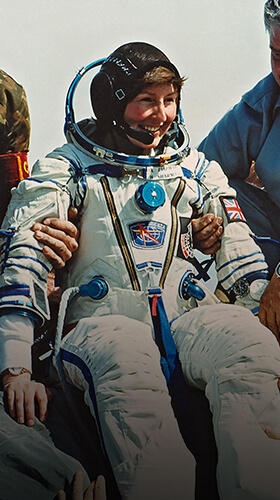
The best space speakers have already done the translation work before they walk on stage. Helen Sharman CMG OBE — the UK's first astronaut, selected from 13,000 applicants for the 1991 Soviet Juno mission — speaks on teamwork, communication, and leadership under extreme conditions in language calibrated for corporate audiences, not science festivals.
For British organisations whose audience may not know every name in the NASA roster, Sharman's cultural authority is distinct: she carries the symbolic weight of a national first combined with the substantive credibility of someone who trained and flew under Soviet mission conditions.
Can they hold a room that did not choose to be at a space conference?
The test for any specialist speaker is whether they can reframe their expertise as the audience's problem — not the speaker's story. That requires preparation at the briefing stage, not improvisation on the day.
Selecting a space speaker is an exercise in wisdom architecture. The right name emerges not from scanning astronaut biographies, but from mapping the wisdom gap in the room first — and Speaker Agency's role is to complete that mapping before a single shortlist is proposed.
Topics Our Space Speakers Cover Most Often
Space speakers are booked across a broader range of corporate event formats than most organiser briefs assume. These six clusters define where demand is strongest — and where the operational knowledge transfers most directly.
Space Exploration & Human Spaceflight — The operational reality of living and working beyond Earth: decision-making when communication with ground control carries a 20-minute lag; what genuine extreme environments reveal about human adaptability and the limits of pre-mission planning.
Risk Management & Catastrophic Failure Analysis — The Challenger, Columbia, and Apollo 1 case studies reframed as executive-level governance frameworks: how organisations normalise deviation, how hierarchies suppress the signals that precede disaster, and what structured failure analysis looks like when the stakes are existential. Directly applicable to regulated industries, safety-critical infrastructure, and board risk committees.
Commercial Space & Entrepreneurship — The new space economy as a live case study in long-horizon investing, stakeholder management under radical uncertainty, and building organisations around goals that most contemporaries dismiss as impossible. Relevant for scale-up events, VC audiences, and innovation summits; often paired with futurist speakers in forward-looking conference programmes.
AI, Technology & Space Innovation — The convergence of space-generated data — earth observation, satellite communications — with enterprise AI applications; directly relevant to technology events examining AI in mission-critical, regulated, and data-intensive environments.
Leadership, Teamwork & Human Performance — Astronaut-grade frameworks for building teams that operate at the limit: decision-making under time pressure, communication discipline in high-stakes environments, and resilience developed through structured adversity rather than theorised in a classroom.
STEM, Diversity & the Future Workforce — Speakers who combine exceptional science credibility with the communication range to serve STEM pipeline events, gender equity programmes, and corporate diversity initiatives — substantive role models, not symbolic ones.
When Should You Book a Space Speaker
Most use cases for space speakers sit outside the obvious science-themed brief. The following seven event contexts are where the return on a space booking is highest.
Innovation and R&D summits — Moonshot thinking under extreme resource and timeline constraints; space exploration is the most demanding lived case study available for long-horizon product development and ambitious programme management.
Risk and resilience conferences — Catastrophic failure frameworks drawn from Challenger and Columbia; applicable directly to boards in financial services, defence, and infrastructure examining how their own decision chains might fail under pressure.
Leadership development programmes — Senior off-sites and high-potential cohort events; the astronaut experience provides an embodied leadership narrative — on teamwork, uncertainty, and performance under pressure — that classroom exercises cannot replicate.
STEM and science education events — Schools, universities, and corporate STEM pipeline initiatives; speakers such as Helen Sharman CMG OBE and Professor Suzie Imber carry both the role-model credibility and the substantive science content these audiences require.
DEI conferences — Space exploration offers a compelling lens on diverse high-performing teams; speakers bring intersectional credibility backed by scientific achievement, which is a different proposition from symbolic representation.
Technology and AI sector conferences — The intersection of space data and AI applications, relevant when enterprise technology events are examining AI in mission-critical or regulated environments.
Entrepreneurship and scale-up events — Commercial space pioneers speak directly to ambitious founders and investors on big-bet decision-making and long-horizon stakeholder management. Morgan Stanley's projection for the global space economy — exceeding $1 trillion by 2040 — means these sessions now carry investment intelligence value for financial services and technology events, not just inspiration value.
How to Choose the Right Space Speaker
The criteria below will narrow a longlist to a shortlist your event will not regret.
Operational vs. communicator credibility — Has this speaker done the thing they describe, or do they speak about people who have? For risk and leadership briefs in particular, practitioner credibility is not optional — an audience of senior executives will sense the difference within ten minutes.
Lesson transferability — Can the speaker demonstrate — in a pre-event briefing, not just a demo reel — exactly how their space experience maps to the specific industry challenge in the room? The best speakers arrive at that briefing with a draft framework already translated into your audience's language.
Audience seniority and technical level — A C-suite risk committee needs a different entry point than a STEM undergraduate cohort. The same mission story lands very differently depending on how the framing is calibrated; confirm this during the brief, not after the contract is signed.
Format match — A 45–60 minute keynote is not the same as a half-day workshop. Space speakers with deep risk or leadership material can often extend into facilitated workshop formats, but this must be confirmed at brief stage and built into the speaker's preparation time.
UK cultural resonance — For British audiences, a UK-connected speaker carries symbolic authority that an international astronaut, however distinguished, does not automatically replicate. Confirm whether UK-specific resonance is a priority for your audience before the shortlist is finalised.
Fee tier and value alignment — Elite active or former astronauts, particularly US-based practitioners, command fees well above the standard corporate range — in some cases significantly above the typical keynote speaker fees in the UK. Confirm budget parameters before shortlisting; the cost guide will calibrate expectations before you open conversations with speaker representatives.
Work through these criteria with the complete guide to hiring a keynote speaker before you finalise your brief — first-time buyers of specialist speaker engagements at this tier will find the preparation investment pays for itself.
How Speaker Agency Helps You Find the Right Match
Identifying the right space speaker for a demanding brief is not a search exercise — it is a strategic design process. Here is how Speaker Agency approaches it.
Map the wisdom gap. Is the brief about catastrophic risk and decision-chain failure? About commercial space innovation and long-horizon investment strategy? About STEM leadership and human performance under pressure? The gap determines everything — an astronaut-turned-risk-analyst serves a fundamentally different brief from a commercial space entrepreneur, and conflating them produces the wrong moment in the room.
Curate the elite voices. Drawing on a 300+ UK roster and a 1,190+ global network, we build a shortlist within 24 hours of receiving a confirmed brief. For space specifically, the shortlist distinguishes between operational practitioners — those who have trained and flown — and expert communicators who cover space as a subject. Both have value, but not for the same brief.
Architect the catalyst moment. The most powerful space sessions are not standalone keynotes — they are transformation blueprints where the speaker's frameworks connect explicitly to the audience's live challenges, whether that is a risk committee examining its own decision-chain, or a leadership cohort stress-testing its performance assumptions against astronaut-grade standards.
Sustain the momentum. The insights from a space risk or leadership session extend well beyond the event itself. Speaker Agency advises on follow-on resources, workshop extension formats, and how to embed the frameworks into existing learning programmes so that the catalyst moment becomes organisational capability, not a conference memory.
Speaker Agency is not a speaker directory — it is a Wisdom Catalyst, designing the conditions under which elite operational knowledge reaches the people and organisations that need it most. With UK and European operations anchored in London and a global network extending to Türkiye and beyond, we match the depth of the brief to the depth of the expertise — wherever in the world that expertise sits.






 After Dinner Speakers

 Discover Similar Topics