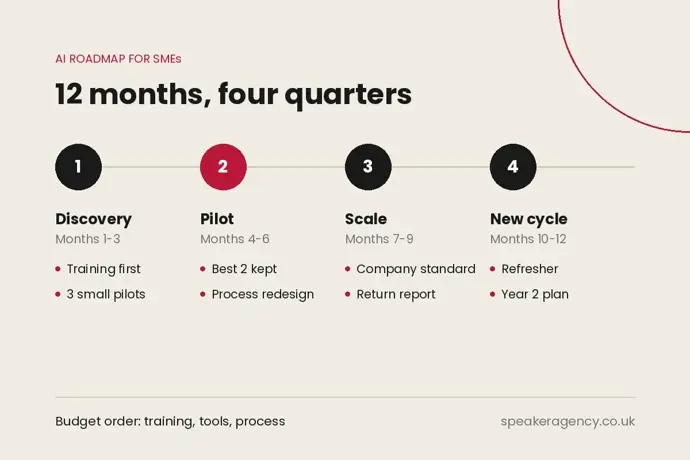
A 12-month AI roadmap for SMEs: four quarters, five measurable gains, the right budget order and notes for owner-managed firms, set out month by month.
At the start of 2025 there were 5.7 million private sector businesses in the UK, and 99.9% of them were small or medium-sized, according to the Department for Business and Trade figures summarised by the House of Commons Library. Most of them are asking the same question about AI: what can it do for a business our size?
The gap is already visible. In the ONS Business Insights and Conditions Survey for June 2026, 28% of businesses with 0 to 9 employees reported using at least one AI technology. Among businesses with 250 or more employees, the figure was 49%.
An SME AI roadmap is a 12-month plan in four quarters (discovery, pilot, scale and a new cycle) that moves AI into the daily operations of a small or medium-sized business. This guide gives you the calendar: what happens each month, the order in which to spend the budget, and the five gains to measure at the end of the year.
Start with the team's learning, then choose the tools with that knowledge.
In August 2025, Fortune reported on MIT research which found that only about 5% of generative AI pilots in companies achieved rapid revenue acceleration. Most stalled without a measurable effect on the profit and loss account. The report pointed to a "learning gap": the tools did not adapt to the workflow, and the organisations did not learn how to fit the tools into their work.
The ONS data points the same way. Among UK businesses with 100 to 249 employees, around 18% said a lack of expertise had delayed AI adoption. Cost was reported by around 7% to 14% of businesses across size bands.
So the largest share of the budget goes to training. Tool licences come second and process redesign third. Reverse the order and the licences reach renewal before anyone uses them properly.
On the training side, 20 to 24 hours carries the programme: a 4-hour strategy session for the owner and leadership team, an 8-hour hands-on workshop for everyone, 4-hour sessions for key functions such as sales, operations and finance, and a refresher after six months. Our AI literacy programme sets out the steps in detail.
On the tool side, a team plan for ChatGPT or Claude for 10 to 15 users, Notion AI or Gamma, and two specialist tools are enough to start: for example, an AI add-on for your CRM and an assistant for customer service.
Five gains to target by month 12
Set targets like these at the start of the year. Your starting point will shape the exact numbers, and the Q1 measurement will show which targets are realistic for you.
Hours saved: 8 to 12 hours per person each week on repetitive tasks.
Customer response time: a 40% to 60% cut in the time it takes to answer service and sales questions.
Content speed: production time for marketing and internal communications cut by more than half.
Decision support: the weekly management pack prepared in half the time.
One new offer: at least one small product or service pilot launched with the help of AI, such as a campaign for a new customer segment.
Track these in a simple return table from month 3. The seven AI ROI metrics give you the columns.
The 12-month plan at a glance
Four quarters, four phases.
Quarter
Phase
Main work
Output at quarter end
Q1 (months 1-3)
Discovery
Training, accounts, 3 pilot use cases
What worked and what did not
Q2 (months 4-6)
Pilot
Build the best 2 use cases into your processes
First rows of the return table
Q3 (months 7-9)
Scale
Company standard, second wave of use cases
Return report
Q4 (months 10-12)
New cycle
Refresher, internal trainer, year 2 plan
Year-end table of the 5 gains
Q1: Discovery (months 1-3)
The rule for this quarter: try, observe, measure. No large tool decision is made before the team has real experience.
Month 1: a 4-hour strategy session for the owner and leadership, team accounts for ChatGPT or Claude, and the first 8-hour workshop on prompting, document summaries and email drafting.
Month 2: each team picks one repetitive task to try with AI. Choose three pilot use cases that are frequent, low risk and measurable, and define the measures: time, quality and error rate.
Month 3: run the three pilots in parallel for 30 days, half the work the old way and half with AI, then write the first quarterly report.
Example: a furniture retailer answers 80 customer messages a week, with an average reply time of six hours. With a team plan and a 3-hour prompting session, the 30-day target is replies in minutes and a missed-appointment rate in single figures.
Q2: Pilot (months 4-6)
Keep the best two use cases from Q1 and drop the third. Keep new experiments to a minimum.
Month 4: redesign the workflow for the two chosen use cases with a process owner, internal or external. Agree which parts AI does, which parts a person does, and which parts they do together.
Month 5: add simple automation, such as connecting a model through Zapier or connecting Claude to Slack, and open one small integration point with your CRM or ERP.
Month 6: 4-hour workshops for sales, operations and finance. By the end of Q2, half the budget is spent and the first rows of the return table are ready.
Example: a 30-person parts supplier takes about two hours to prepare a quote. An assistant connected to the product catalogue finds the part, updates the price and drafts the quote; a colleague checks and sends it. The target is a quote in under 30 minutes, with the time saved going to customer visits.
Q3: Scale (months 7-9)
Roll out what worked across the business and add one new use case. The aim for this quarter is regular AI use by 70% of the team.
Month 7: the Q2 use cases become the company standard. Write a plain 5 to 7-page AI usage guide and add AI to the induction for new starters.
Month 8: test one new area outside the first three pilots, such as marketing content, quote follow-up or internal reporting, with the same 30-day pilot logic.
Month 9: the return report compares hours saved, multiplied by the cost of an hour, with the budget spent.
Example: in a 50-person distribution business, the customer service assistant is rolled out to the whole team. When one adviser leaves, the role is not refilled. The measure to watch is how customer satisfaction (NPS) moves over the same period.
Q4: New cycle (months 10-12)
By the end of year 1, the business has moved from trying AI to using it routinely. Q4 is a refresher and the start of the year 2 plan.
Month 10: a 4-hour refresher on new models and features from the past six months, and one or two internal trainers chosen from the heaviest users.
Month 11: the year 2 roadmap. Use cases parked in Q1 come back to the table, the year 2 budget is usually higher (licences and advice), and a move to AI agents is planned for mid-year. Our first AI agent decision matrix helps with that step.
Month 12: show the five gains in one table, gather feedback from the team and share the year-end report openly inside the business.
Owner-managed businesses: three notes
Many UK SMEs are run by their founders or by families, and three issues come up often.
Generations. The next generation often wants AI and the founder hesitates. Ask the founder to use AI in their own daily work first, such as a supplier letter or an invoice summary. When they say "this works" within a week, the rest of the plan moves faster.
Shared ownership. Where the business has professional managers alongside the owners, who leads the project can become political. Split the roles: a sponsor from the ownership side and a project lead from the management team.
Cash discipline. Owner-managed firms protect cash, and "I won't put the budget into an experiment" is a common line. Split the budget into quarterly slices. At the end of Q1, decide to continue or stop, and the risk stays small.
Which tool for which job?
Job
First choice
Second choice
Email and internal writing
ChatGPT or Claude (team plan)
Notion AI
Answering customer questions
ChatGPT or Claude
Your CRM's AI add-on
Preparing quotes
Claude with Excel or Sheets
ChatGPT
Content (social media, blog)
ChatGPT or Claude
Gamma and Canva
Summarising long documents
Claude
ChatGPT
Light data analysis
ChatGPT or Claude
AI features in Excel or Sheets
Presentations
Gamma
Beautiful.ai
Meeting notes
Otter or Fireflies
Granola
Treat the table as a starting point. In practice an SME runs 2 or 3 tools, and each extra tool adds to the team's learning load.
Which speaker fits which stage?
An outside voice helps most at two points: the leadership session in month 1 and the refresher in month 10. Some examples from our roster:
Leadership kick-off: Zack Kass, former Head of Go To Market at OpenAI, gives owners and leadership teams a clear picture of where AI is heading.
Choosing use cases: Cassie Kozyrkov, who served as Google's Chief Decision Scientist, works on how leaders decide what AI should and should not be used for.
Training-first strategy: Yuce Zerey, AI strategy and transformation speaker and founder of Growingo AI, builds the plan around the team's learning.
Year 2 and scaling: Sol Rashidi, author of Your AI Survival Guide, focuses on moving AI from pilots into everyday operations.
Data readiness sits under every stage of the plan. This short talk covers why decisions start with data:
Pick one weekly task in your business that takes at least 5 hours. Invite the person who does it to a 30-minute ChatGPT or Claude session tomorrow. By the end of that session you will both see what one workshop can save.
Plan your team's AI training with us
Tell us your team size and priorities, and we will suggest the right format and speaker. We reply to every enquiry within 24 hours.
In the ONS Business Insights and Conditions Survey for June 2026, 28% of businesses with 0 to 9 employees reported using at least one AI technology, compared with 49% of businesses with 250 or more employees. Across businesses with 10 or more employees, use rose from around 12% in late 2023 to around 35%.
What should an SME with a small budget do first?
Narrow the scope and start with training. A single team plan for a few users, one internal owner working part-time on the process, and three small pilots are enough for the first quarter. Decide at the end of Q1 whether to continue.
What is the most common mistake SMEs make with AI?
Buying tools before the team knows how to use them. Licences then renew without real use. The order that works is training, use case, tool, then process redesign.
How long before an SME sees a return on AI?
Plan for the first signals within six months. The Q1 pilots show which use cases save time, and by the end of Q2 the first rows of the return table should be ready. Set a clear continue-or-stop decision at the end of Q1.
Who should lead AI adoption in an owner-managed business?
Shared ownership works well: an owner acts as sponsor and holds the budget and final decision, and a manager from outside the family or founding team leads the project day to day.
Do SMEs need AI agents in year 1?
Agents fit best in the second half of year 2, once the team uses AI routinely and the data is in order. Year 1 is for the habits, the standards and the return table.






 After Dinner Speakers


 Contents