
The wellbeing day went well. The room was full, the speaker was good, the feedback scores were high. Three months later, the team's burnout survey sits exactly where it did the year before.
A workplace wellbeing programme is a sequence of sessions, manager actions and measures, designed to change working conditions over months and built around one or two outcomes the organisation tracks from the start. A single event can open that sequence; the months that follow do the lasting work.
The pressure behind the question is real. In Great Britain, 964,000 workers reported stress, depression or anxiety caused or made worse by work in 2024/25, according to the Health and Safety Executive.
If you need the case for why wellbeing matters at all, we covered it in Wellbeing at Work. This piece starts one step later: how to design a programme that lasts.
What does the evidence say about one-off sessions?
The most direct UK evidence comes from Oxford. In January 2024, William Fleming of the University of Oxford's Wellbeing Research Centre published an analysis of 46,336 workers across 233 UK organisations. He found no evidence that individual-level interventions such as mindfulness, resilience training, stress management, relaxation classes or wellbeing apps improved the wellbeing of the people who took part.
His conclusion was blunt: "organizations have to change the workplace and not just the worker." He pointed to organisational changes, such as scheduling, management practices, staff resources, performance review and job design, as the more promising route.
A broader view came in June 2025. An umbrella review in The Lancet Public Health by Virtanen and colleagues pooled 88 systematic reviews and 339 meta-analysed effect estimates published between 2011 and 2024. Effects at the individual level were generally modest, though they could be meaningful across a whole workplace or population. Only 21% of the estimates rested on moderate-quality evidence.
The two studies differ on how much individual sessions achieve. They point the same way on design: a session on its own carries little weight, and the conditions around it decide how much of it survives.
Why one session fades
Three structural reasons come up again and again in practice.
Content that ignores context. A shift worker on a production line and a knowledge worker at head office carry different stressors. A generic stress talk reaches both and changes neither.
No protected time. Many wellbeing events land after hours or over lunch. The people who attend are rarely the ones under the most pressure, because those people cannot get away.
No repetition. One session raises awareness. Awareness turns into behaviour only with repetition, and without it the effect fades within weeks.
How is a wellbeing programme built?
Four layers do the work, each with a different job.
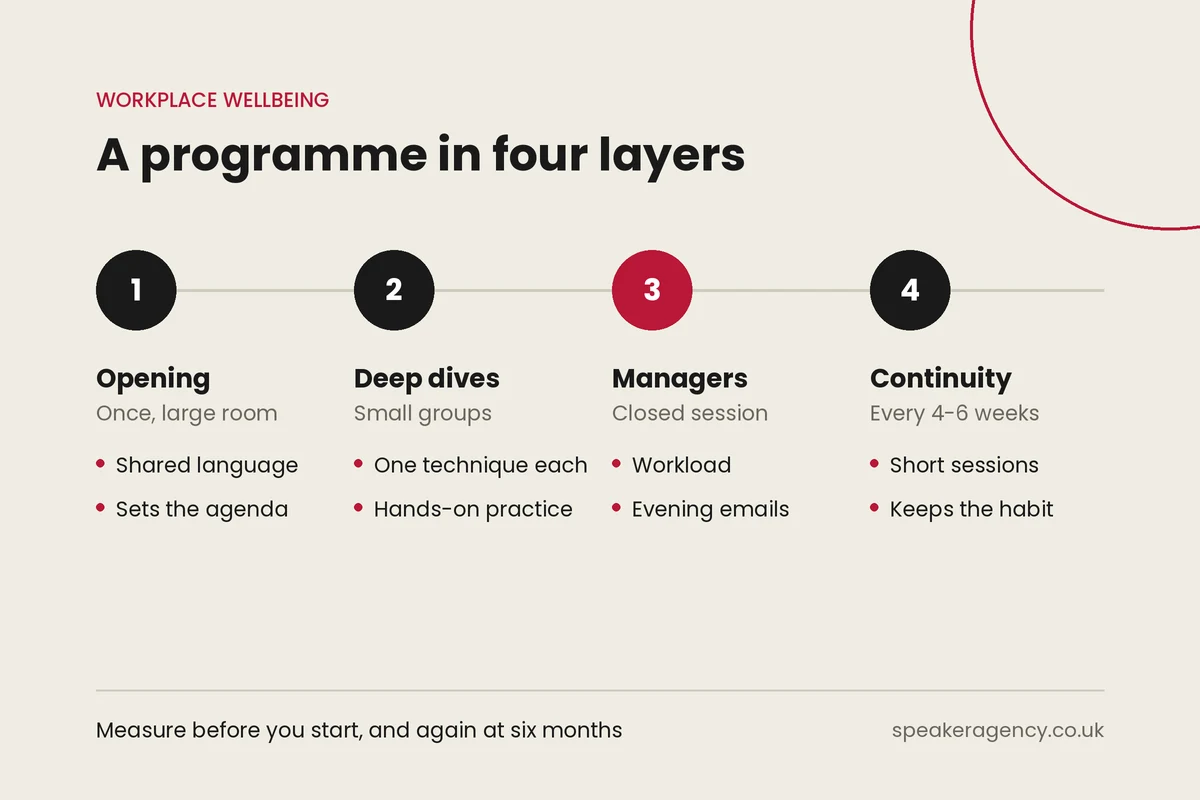
| Layer | What it does | Format | Speaker profile |
|---|
Opening session | Introduces the topic and gives the organisation shared language | Large room, once | Author or keynote speaker with broad appeal |
Deep-dive modules | Teaches one technique at a time, such as sleep, boundaries or stress response | Small groups, hands-on | Clinician or psychologist |
Manager layer | Changes the conditions people work in: workload, out-of-hours contact, feedback | Closed session for line managers | Workplace psychologist |
Continuity rhythm | Keeps the habit alive between big moments | Short sessions every 4-6 weeks, often online | Practitioner with a practical routine |
The manager layer is the one organisations skip most often, and it is the one closest to Fleming's finding. Line managers set workload, decide whether evening emails need an answer and shape how feedback lands. A programme that trains employees while leaving those conditions untouched asks people to cope better with the same pressure.
The budget and format logic behind these layers follows the same pattern we set out in Four Formats, Four Different Outcomes. Wellbeing is one of the clearest places where that distinction shows up.
What a six-month programme can look like
| Month | Layer | What happens |
|---|
1 | Measurement, then opening | Baseline reading on two measures, followed by the opening session |
2 | Manager layer | Closed session for line managers on workload, out-of-hours contact and feedback |
2-3 | Deep dives | Two small-group modules on the topic the baseline flags most |
3-6 | Continuity rhythm | Short sessions every 4-6 weeks, often online |
6 | Measurement | Second reading on the same two measures, then a decision on the next six months |
The order matters more than the exact months. The baseline comes first so that the result means something, and the manager session comes early so that the deep dives land in changed conditions.
Which speaker fits which layer?
Each layer calls for a different kind of expert. Some examples from our roster:
- Opening session: Oliver Burkeman, author of the Sunday Times bestseller Four Thousand Weeks, gives a large room a shared way to talk about time, limits and pressure.
- Deep-dive modules: Owen O'Kane, psychotherapist and former NHS clinical lead, works on the mechanics of mental health and resilience.
- Manager layer: Lee Chambers, psychologist and founder of Essentialise Workplace Wellbeing, works on the workplace side of wellbeing.
- Measurement: Matt Phelan, co-founder of The Happiness Index, brings the discipline of tracking how people feel at work over time.
- Continuity rhythm: Dr Alka Patel, a lifestyle medicine doctor, focuses on small daily habits that fit a regular session cadence.
Decide which layer you are filling before you choose the person. The shortlist narrows itself once that is clear. The full range sits on our wellbeing speakers page.
How do you measure whether it worked?
Participant satisfaction is a weak signal. Everyone can leave a session happy while nothing in the team changes.
Two or three outcome measures give a clearer picture:
- Sickness absence days
- A burnout scale score, taken before the programme and again six months later
- Job satisfaction and self-rated health in the staff survey
- Quality of manager feedback, as rated by the team
Take the first reading before the programme starts. A measure added afterwards has nothing to compare against, so it only gives you a snapshot.
Where to start this quarter
A single wellbeing day has a place: as the opening of a programme. The trouble starts when the opening is treated as the whole programme.
- Mark which of the four layers you already run: opening, deep dives, managers, continuity. The missing one is your starting point.
- Choose two measures and take a baseline reading before anything else happens.
- Put the manager layer in the plan from day one.
Planning a wellbeing programme for the months ahead?
Tell us which layer you are missing and we will suggest the right format and speaker for it.
Frequently Asked Questions
Does a one-off wellbeing session work at all?
It can raise awareness, but the effect is small on its own. A 2024 Oxford study of 46,336 UK workers found no measurable wellbeing benefit for people taking part in individual-level interventions such as mindfulness or resilience training. A one-off session works best as the opening of a longer programme.
Should we book a psychologist or a motivational speaker?
It depends on the layer. A motivational speaker or author suits the opening session and large rooms. A clinician or psychologist suits deep-dive modules and manager sessions, because they teach how stress and recovery actually work. Many programmes use both.
Why do managers need their own session?
Line managers set workload, out-of-hours expectations and the way feedback is given, which are the conditions that shape wellbeing day to day. Research from Oxford points to changes in management practices and job design as a more promising route than individual training alone.
Should wellbeing sessions run in working hours?
Yes, where possible. Sessions held after hours or over lunch tend to reach the people with the most spare time, and miss those under the most pressure.
How do we measure a wellbeing programme?
Track outcomes: sickness absence days, a burnout scale score, job satisfaction, self-rated health and the quality of manager feedback. Take a baseline before the programme starts so there is something to compare against.







 After Dinner Speakers


 Contents