Transformation happens at the intersection of knowledge and action. The best Disruptive Change Speakers UK organisations commission are built on exactly that premise — not the comfortable reassurance that change is manageable, but the harder, more useful idea that disruption survived well is a competitive position.
UK boards in 2026 face three concurrent pressures: AI-driven compression of operating models, incomplete post-pandemic workforce restructuring, and macro-economic force reshaping revenue assumptions that held for decades. McKinsey's data on transformation failure is the backdrop every senior event organiser carries into a brief: only 26% of organisational transformations are considered successful by the executives leading them.
The audience that leaves your event with a framework they can act on Monday morning is a different audience from one that leaves energised but unequipped. Speaker Agency doesn't locate speakers who speak about disruption — it architects the wisdom transfer that converts disruption pressure into board-level capability.
Why Hire a Disruptive Change Speaker for Your Event
That 26% transformation success figure is not a curiosity — it is the capability gap a disruptive change speaker is commissioned to close. The question is which dimension of that gap your event needs to address.
Disruption Readiness vs. Disruption Response captures the competitive asymmetry that separates organisations positioned ahead of structural change from those absorbing the cost of reacting to it. For financial services, retail and manufacturing buyers in particular, this is the sharpest framing: the difference between a firm that anticipated AI's effect on its operating model and one that is now funding two transformation programmes simultaneously.
A speaker who has lived on the right side of that asymmetry — who has prepared an organisation rather than rescued one — delivers a case for investment, not a post-mortem.
Human Factors Inside Disruptive Change is the angle that CHRO and People function buyers need articulated before their board will fund a meaningful session. Resistance is not irrational; it is information. Decision fatigue, psychological safety collapse and cultural inertia are not soft concerns — they are the mechanisms by which well-designed transformation programmes stall at the implementation stage. Speakers who have operated inside these dynamics, rather than advised on them from a distance, give HR and People leaders the language to take back to their own leadership teams.
Leading Transformation When You Can't Predict the Endpoint addresses the execution gap that no change management framework fully resolves: the senior leader managing a large-scale programme — AI integration, post-merger consolidation, regulatory overhaul — whose destination keeps shifting. This is not a methodological problem; it is a judgement problem. The speakers who speak most usefully to this challenge are those who have made irreversible decisions under genuine uncertainty, not those who have modelled the scenarios from a consulting engagement.
The choice of sub-angle shapes everything downstream — who sits in the room, what they take away, and whether the session registers as a strategic intervention or a well-delivered motivational hour.
What Sets a Great Disruptive Change Speaker Apart
The line between a practitioner and a commentator matters more in this topic than almost any other. Disruption, by definition, is not something most organisations choose — and the audiences who have lived inside it recognise within three minutes whether the person on stage has too.
Have they lived through disruption at scale?
A speaker who operated inside a genuine, non-negotiable change — not one who consulted on it, framed it, or wrote about it — carries an authority no credential replaces.
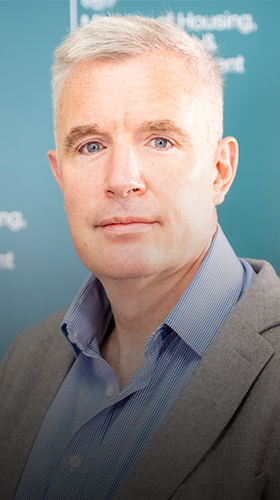
Andy Roe, Former Commissioner of the London Fire Brigade, led institutional transformation under some of the most pressurised conditions any public-sector leader faces: the Grenfell aftermath, pandemic operational demands, and the sustained requirement to reform a complex institution while continuing to run it at full capacity. There was no pilot phase; there was no iterative runway. That experience answers questions a strategist cannot.
Do they give audiences a framework, not just a story?
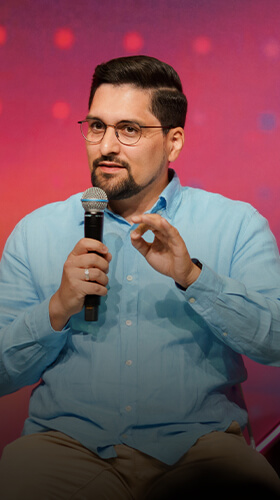
Narrative without structure is motivation that dissipates by the following Tuesday. The best disruptive change speakers leave a room with a mental model — a way of categorising the disruption signals they are seeing and deciding which require immediate response and which require positioning. Azeem Azhar, founder of Exponential View and author of The Exponential Age, works at exactly this level: mapping the structural forces that accelerate technology disruption and giving strategic audiences a coherent way to read competitive dynamics that otherwise appear chaotic.
Can they calibrate to a room of sceptics?
Risk officers, CFOs and engineering leads push back on change agendas — not because they resist change, but because they have seen transformation programmes over-promise and under-deliver. A speaker who can hold that room, absorb the challenge and redirect it productively is a different animal from one who performs well in front of an enthusiastic audience. Confirm the speaker's experience with questioning rooms before finalising any senior-leadership booking.
The contrast between Azhar and Roe illustrates that "great" is not a single archetype — it depends entirely on the event's primary question. Choosing between them is an act of wisdom architecture, not speaker selection. For events where the primary question is process-level rather than systemic — where the audience needs implementation methodology rather than strategic framing — change management speakers may be the stronger fit, and Speaker Agency's briefing process identifies that distinction before any name reaches a shortlist.
When Should You Book a Disruptive Change Speaker
With 39% of existing skill sets projected to be disrupted or transformed by 2030 (WEF Future of Jobs Report 2025), the structural timeline driving event commissioning decisions is no longer abstract — it is inside the current strategic planning cycle for most UK organisations. These are the moments where a disruptive change speaker delivers most sharply:
Strategy Away-Days and Board Off-Sites — Senior leadership teams resetting direction in response to market or competitive disruption; speakers who challenge assumptions rather than validate existing plans.
Annual Company Conferences and All-Hands Events — Organisations mid-transformation using a keynote to build workforce alignment and reduce change resistance before it compounds.
C-Suite and Executive Development Programmes — Leadership academies needing an external voice on managing through uncertainty rather than simply reacting to it.
Industry Association Summits and Sector Conferences — Trade bodies in financially regulated, energy, retail or healthcare sectors commissioning sessions that give member organisations a shared disruption framework.
Innovation Days and Transformation Kickoffs — Internally-run events launching major change programmes; a disruptive change speaker provides external credibility and forward momentum. Forward-looking strategy events here sometimes combine disruption content with future trends speakers for a broader strategic arc.
Risk and Resilience Committees — Board-level audiences reviewing how technology, geopolitical and climate disruption will reshape risk over a 3–5 year horizon.
Sales Kickoffs and Commercial Team Conferences — Commercial organisations where market disruption is threatening existing revenue models; speakers on competitive disruption and adaptive strategy.
These use cases rarely arrive in isolation — a board off-site that begins with disruption readiness often feeds directly into a transformation kickoff two months later.
Topics Our Disruptive Change Speakers Cover Most Often
"Disruptive change" is a broad commission — the brief that lands at our desk can mean AI automation, competitive displacement, regulatory overhaul or cultural collapse under rapid change mandates. The following clusters reflect where demand actually concentrates:
AI-Driven Disruption and Automation — How AI compression reshapes decision cycles, roles and operating models in real time; the most-requested cluster across financial services, professional services and manufacturing audiences in 2026.
Post-Pandemic Organisational Reset — Incomplete workforce restructuring, the permanent settlement of hybrid models, and the leadership gaps that emerged from two years of sustained crisis management and have not yet been filled.
Competitive Disruption and Market Dynamics — How new entrants, platform shifts and changing buyer behaviour overturn established revenue models; particularly acute for retail, media and transport sector buyers.
Leading Change in Regulated Industries — Sector-specific disruption in financial services, energy, healthcare and professional services, where regulatory change compounds technology pressure and the margin for error is narrow.
Human Factors and Culture in Transformation — Resistance management, psychological safety, change fatigue and the cultural inertia that causes well-designed transformation programmes to stall at the point of implementation rather than the point of design.
Technology Adoption and Workforce Disruption — The adoption curve for enterprise technology and the reskilling and workforce transition decisions that accompany it — the operational translation that many strategy-level disruption sessions leave unaddressed.
Most bookings combine two or more of these clusters, and Speaker Agency's briefing process identifies which combination serves a given audience before any speaker is named.
How to Choose the Right Disruptive Change Speaker
The selection decision is sharper than it first appears. These criteria give it structure:
Sector fit — A speaker who has operated inside your sector reads the room differently; generic disruption narratives land less well with specialist professional audiences who can immediately identify when an example is borrowed rather than lived.
Practitioner versus commentator — Has the speaker led through disruption in an organisation, or analysed it from the outside? Both have a place, but the choice must match the event's primary question — strategic framing or operational reality.
Format match — A 45–60-minute keynote and a 3-hour executive workshop demand fundamentally different things; not all disruptive change speakers are built for both, and booking the wrong format wastes the speaker's strengths.
Audience seniority — C-suite audiences need frameworks with board-level implications and macro-strategic anchoring; middle management needs operational translation and actionable takeaways. Calibrate accordingly, not aspirationally.
Time horizon — Is the audience managing disruption that is already inside the building, or preparing for disruption that is 2–5 years out? The speaker whose natural frame is retrospective analysis serves the first need; the speaker whose natural frame is systemic forecasting serves the second.
Sceptic readiness — Risk officers, CFOs and engineering leads tend to push back on change agendas. Confirm the speaker has held a questioning room — not just an enthusiastic one — before committing to a senior leadership booking. For organisers still forming the commercial brief, guidance on how much a keynote speaker costs in the UK sets realistic expectations before the shortlisting conversation begins; corporate-calibre disruptive change speakers start at £5,000, with top-tier practitioners reaching £50,000.
How Speaker Agency Finds Your Disruptive Change Speaker
The distance between a compelling disruption keynote and a session that actually shifts how a room thinks is almost always in the preparation, not the speaker.
Map the wisdom gap. Before recommending a single name, we establish which disruption challenge the organisation is actually facing — whether that is structural technology disruption, a failing internal transformation programme, competitive market shock, or the human-system breakdown that commonly accompanies rapid change mandates.
Curate the elite voices. From a 300+ UK roster and a 1,190+ global network, we identify speakers whose disruption experience matches the specific challenge — not the broadest credentialed name, but the right practitioner or systemic thinker for this audience. A shortlist reaches the client within 24 hours.
Architect the catalyst moment. We work with the selected speaker and the event organiser to build the transformation blueprint: format, sequencing, audience calibration, and the precise framing that converts a disruption keynote from a compelling talk into an actionable shift in how the room thinks and decides.
Sustain the momentum. Disruption does not resolve after the applause. We support post-event follow-on — whether that is a workshop series, a leadership conversation, or a structured debrief — to ensure the catalyst moment extends into organisational behaviour rather than evaporating in the car park.
Speaker Agency operates as a Wisdom Catalyst for disruptive change events specifically — working across the UK, Europe and Türkiye to ensure clients access the right voice regardless of geography, sector or disruption type. The difference between a forgettable keynote and a strategic intervention is the wisdom architecture behind the booking: who asked the right questions before the brief was written, and who designed the session around what the audience needs to leave knowing, not simply what the speaker is prepared to say.







 After Dinner Speakers

 Discover Similar Topics