Your next breakthrough is one wisdom transfer away. The demand for disruptive innovation speakers in the UK has sharpened considerably in 2026 — not because disruption is a new concept, but because the April UK AI Opportunities Action Plan, committing £14bn in private investment and establishing AI Growth Zones, moved it from a strategy offsite agenda item to a board-level mandate overnight.
UK incumbents in financial services, energy, retail, and professional services are no longer debating whether disruption will reach them — they are deciding whether to be the attacker or the attacked. C-suite audiences registering for innovation events are signalling that distinction clearly: they want practitioner credibility, not keynote inspiration. Speaker Agency doesn't match names to calendar slots; it architects the wisdom transfer that turns disruption anxiety into competitive advantage.
Why Hire a Disruptive Innovation Speaker for Your Event
The boardroom urgency around disruption in 2026 is structural, not cyclical — and most UK incumbents are underprepared precisely because of their strengths.
The Incumbent's Dilemma positions the problem at its sharpest: the governance cycles, legacy infrastructure, and market assumptions that made large organisations in financial services, energy, and professional services dominant are now calibrated to a world that is shifting beneath them. Scale creates drag. Market position creates blindness. Strategic planning horizons are built around protecting what exists, not building what comes next.
A disruptive innovation speaker who has operated from the attacker's side can expose that gap in twenty minutes — and do it in a room where the CEO's instinct is to defend.
From Theory to Execution addresses the second failure mode. Christensen's innovator's dilemma, Blue Ocean Strategy, and Jobs-to-be-Done are boardroom-familiar. The frameworks are not the problem — they are on the reading list, referenced in board papers, cited in strategy decks. What organisations lack is the implementation layer: what happens when you attempt to execute a disruption strategy inside a real organisation with real budget battles, inherited technology, and stakeholder resistance.
A speaker who has lived that execution gap — who can answer the question "but what did you actually do when the legacy business pushed back?" — carries information that no framework can.
Disruption as Competitive Architecture reframes the conversation entirely. The proactive case is not about survival; it is about building attacker mindsets, internal innovation governance, and resource allocation models that let an organisation be the disruptor before a well-capitalised challenger forces the change. McKinsey research consistently shows that organisations prioritising bold innovation and resilient strategic moves outperform peers on total shareholder return over the long run — and that the speed at which industry revenue pools shift when a major enabling technology reaches mainstream adoption makes early positioning a commercial necessity, not a strategic preference.
The choice of speaker angle — defensive urgency, execution translation, or offensive architecture — determines what the room walks away willing to do. That choice belongs in the brief, not the booking confirmation.
What Sets a Great Disruptive Innovation Speaker Apart
The practitioner-versus-commentator distinction is sharper in disruptive innovation than in almost any other topic — because audiences in this space are sophisticated enough to know the difference within the first ten minutes.
Have they shipped something?
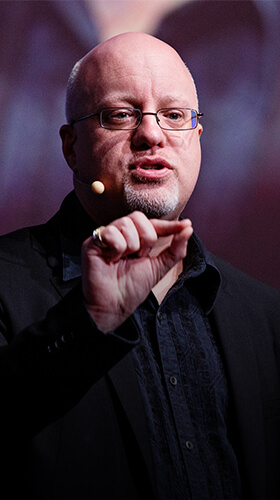
A speaker who co-founded a product that disrupted an entire interaction paradigm can answer questions about implementation failure, investor pressure, and the decision to kill a working product line in ways that no strategist or academic can. Adam Cheyer co-founded Siri and Viv Labs — building platform-level disruption from a research prototype to a technology used by hundreds of millions. That firsthand knowledge of what it takes to move from innovation concept to scaled commercial reality is the implementation layer most corporate audiences are actually searching for.
Do they speak to your specific disruption vector?
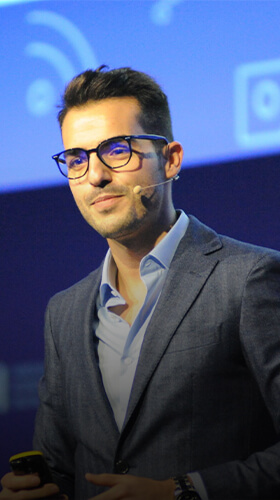
Technology disruption, business model disruption, and sustainability-led disruption are not interchangeable narratives — they require different practitioners with different sector credibility. Ambarish Mitra, WEF Technology Pioneer and founder of both Blippar and Greyparrot, demonstrates disruption across consumer platforms and sustainability-led business model reinvention — a range that makes him unusually well-placed for audiences whose disruption challenge spans digital transformation and net-zero strategy simultaneously. A speaker whose experience sits in a single disruption channel, matched to the wrong sector, signals curation failure before a word is spoken.
Can they hold a room of sceptics?
Finance directors, risk officers, and established-sector managing directors push back on disruption narratives from a position of earned experience — their resistance is not obstruction, it is the weight of operational reality. The WEF Future of Jobs Report 2025 finds that 39% of existing skill sets are expected to be transformed or become outdated by 2030, yet the rooms most in need of that insight are also the hardest to move. First-hand credibility is what neutralises that resistance; inspiration alone does not.
The right disruptive innovation speaker is not a programme item — they are a wisdom architecture decision that shapes how the room thinks for the next twelve months.
Topics Our Disruptive Innovation Speakers Cover Most Often
Disruptive innovation spans technology, strategy, culture, and entrepreneurship — and the right topic angle depends entirely on where your organisation currently sits on the disruption curve. Our futurist speakers cover the horizon-scanning dimension; the practitioners below address the live strategic challenges most often brought to us by UK event organisers.
- AI and emerging technology as disruption vectors — How generative AI, automation, and frontier technologies are shifting competitive advantage and rendering established business models obsolete faster than most strategic planning cycles can track.
- Incumbent business model redesign — How established organisations can dismantle and rebuild their value propositions before a challenger does it for them — the strategy and governance mechanics of self-disruption, not just the theory of it.
- Innovation culture and attacker mindsets — The behavioural and structural conditions — resource allocation, failure tolerance, cross-functional teaming — that separate organisations which consistently innovate from those that produce innovation theatre.
- Market creation versus market capture — The distinction between competing for existing demand and creating a new market category, and why most incumbent strategy is calibrated entirely for the former.
- Disruptive entrepreneurship and scaling — Lessons from founders who built entirely new categories: the decision-making, capital allocation, and talent strategies that allowed disruption to scale rather than stall.
- Sustainability-led disruption — How the net-zero transition and circular economy imperatives are generating structural disruption opportunities, and why the most credible voices in this space combine commercial and environmental fluency in equal measure.
When Should You Book a Disruptive Innovation Speaker
The use cases below cover the moments when a disruptive innovation speaker shifts from a compelling programme idea to the most strategically important booking on the calendar.
- Strategy away-days and leadership offsites — Where boards are stress-testing business model assumptions and need an external practitioner voice to challenge comfort-zone thinking credibly — not to validate the strategy that is already in the room.
- Annual conferences and company kick-offs — Where setting competitive urgency for the year ahead is the primary objective; a disruption speaker calibrates ambition against external market reality rather than internal aspiration.
- Innovation summits and internal innovation days — Dedicated events designed to generate new ideas, break silos, or formally launch an internal venture or incubator programme — where the speaker's firsthand experience legitimises the mandate.
- Digital transformation programme launches — Where a speaker who has driven real disruption gives change-fatigued organisations a credible, evidence-based reason to commit rather than defer.
- Investor and stakeholder days — Where demonstrating that leadership understands and is proactively responding to sector disruption is part of the event's commercial and reputational narrative.
- C-suite and NXD development programmes — Where a practitioner perspective on attacker mindsets or market disruption mechanisms supplements formal leadership curriculum with the implementation layer it typically lacks.
- Industry association and sector conferences — Where trade bodies want to signal forward momentum; a recognised disruptive innovation speaker generates delegate registrations independently of the broader programme.
If the goal is sustained cultural change rather than a single catalyst moment, disruptive change speakers may be the stronger programme fit — the distinction matters at briefing stage, not after contracts are signed.
How to Choose the Right Disruptive Innovation Speaker
Each criterion below functions as a literal briefing-call question — the kind that separates a well-matched speaker from a credible one who happens to be available.
- Sector fit — Does the speaker's disruption experience map to the audience's industry? A FinTech founder speaking to an energy sector board can work powerfully — but it requires explicit bridging. A speaker with cross-sector range, moving fluently between platform technology and sustainability, broadens fit considerably and reduces the briefing workload.
- Practitioner versus commentator — Has the speaker built, launched, or led through disruption firsthand, or do they synthesise others' experiences? Both profiles have merit — a practitioner answers the implementation question; a commentator synthesises patterns across industries. Knowing which question your audience is actually asking determines which profile you need.
- Format match — A 45-minute keynote that reframes strategic thinking is structurally different from a half-day workshop that builds attacker-mindset tools. Mismatching format to objective is the single most common booking error — and the one most easily avoided at brief stage.
- Audience seniority and scepticism level — C-suite and NXD audiences require first-hand credibility to override earned resistance; they have heard frameworks before. Innovation team audiences may respond better to a practitioner-peer with hands-on tool experience than to a founder whose operating context is remote from theirs.
- Time horizon of the disruption conversation — Is the event addressing an immediate competitive threat — requiring urgency, specificity, and near-term action framing? Or is it about future-state architecture, requiring broader visionary range? These are different cognitive demands on the speaker and they pull toward different profiles.
- Budget and investment level — Disruptive innovation speakers with proven practitioner credentials typically start from £5,000 in the UK; recognised Silicon Valley founders and globally profiled thought leaders sit toward the higher end of the range. See what a keynote speaker costs in the UK for a full fee-tier breakdown by format and speaker profile.
How Speaker Agency Helps You Find the Right Match
The brief that lands the right speaker is built on a diagnosis, not a job description — and that distinction is where the process starts.
- Map the wisdom gap. We identify precisely where your organisation sits on the disruption curve — whether you are defending an eroding position, launching an internal innovation programme, or preparing leadership to make an offensive strategic move — so the speaker brief reflects your actual strategic challenge, not the event theme.
- Curate the elite voices. From a 300+ UK roster and a 1,190+ global network spanning Silicon Valley founders, WEF Technology Pioneers, and sector-specific disruption practitioners, we deliver a calibrated shortlist within 24 hours — aligned to your industry, your audience's scepticism level, and your event's specific transformation objective.
- Architect the catalyst moment. We design the transformation blueprint around the speaker — format, sequencing, pre-event framing, and post-session integration — so the keynote functions as the pivot point in a structured wisdom transfer, not a standalone performance.
- Sustain the momentum. The catalyst moment is the ignition, not the destination; we support post-event follow-on — whether a workshop series, a leadership reading programme, or a return booking for the next strategic cycle — to convert the room's energy into durable organisational change.
Speaker Agency operates as a Wisdom Catalyst and Knowledge Architect, not a speaker broker. With reach across the UK, Europe, and Türkiye, and a global network of 1,190+ speakers, we architect the entire wisdom transfer — from the diagnostic brief to the breakthrough in the room — and we remain engaged until that breakthrough compounds into something measurable.
Ready to Book a Disruptive Innovation Speaker?
The disruption pressures shaping UK boardrooms in 2026 will not pause for the next planning cycle. If you have read this far, you already know the speaker selection decision is a strategic one — and the right wisdom transfer, timed correctly, can shift how an entire leadership team thinks before the next competitive threat becomes visible. Tell us your event brief, your audience, and the strategic question you need the room to leave with — we will return a calibrated shortlist within 24 hours.
📞 +44 (0) 20 3393 1061
✉ info@speakeragency.co.uk
🌐 [Contact form link]







 After Dinner Speakers

 Discover Similar Topics